
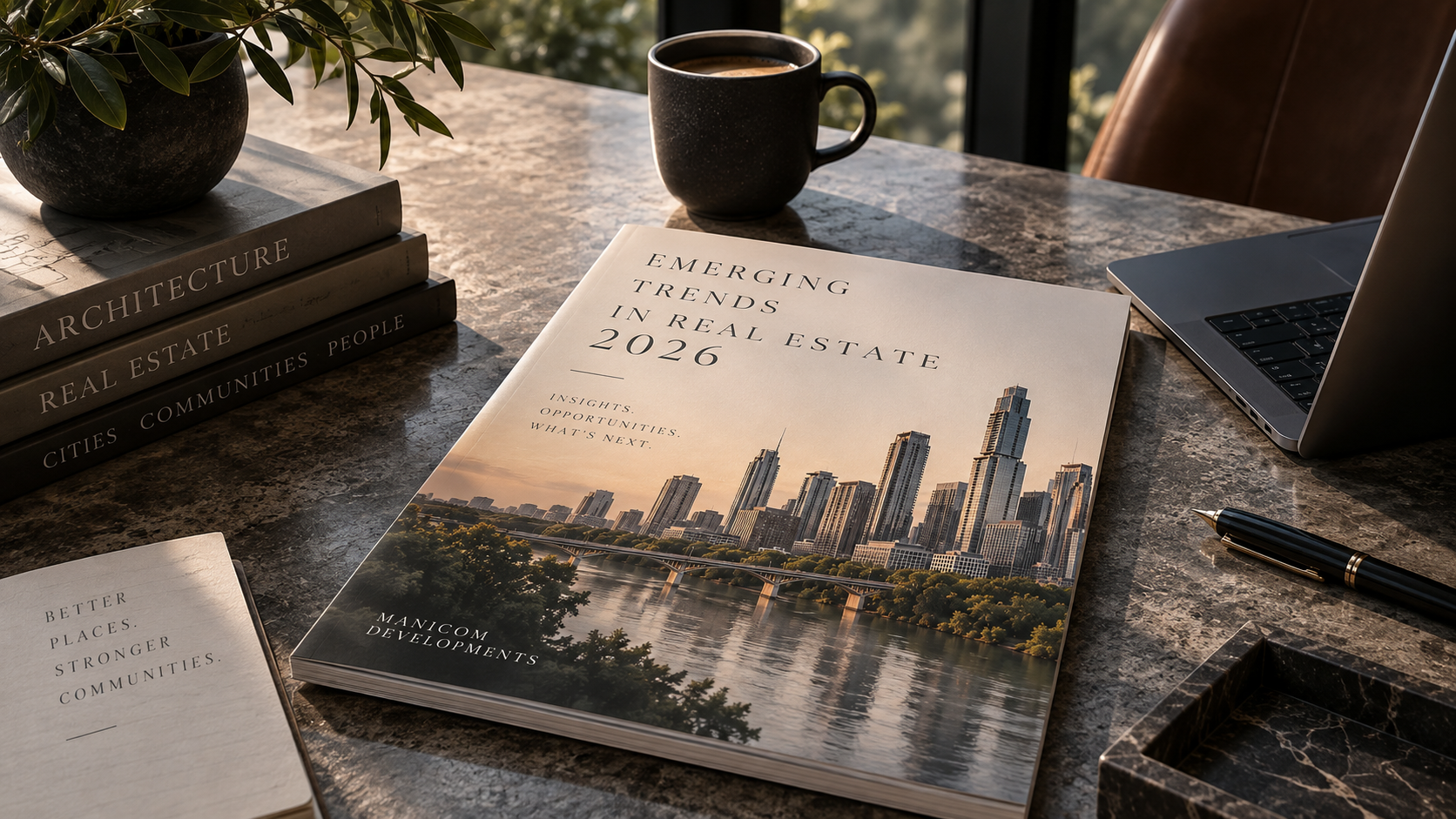
Emerging Trends in Real Estate 2026: A Market Defined by Selectivity

A year ago, the real estate industry appeared to be entering a new cycle. In 2026, that transition is becoming clearer but the recovery is neither uniform nor simple.
The 47th edition of Emerging Trends in Real Estate®, published by the Urban Land Institute and PwC, describes an industry being reshaped by higher capital costs, changing demographics, artificial intelligence, evolving consumer expectations, and a growing emphasis on operational performance.
The opportunity is returning, but so is discipline.
For developers and investors, 2026 may be less about participating in a broad market recovery and more about identifying the right property, in the right market, for a clearly defined end user.
Capital Markets Remain in the Fog
Capital is becoming more available, but the environment remains considerably more complex than the low-rate era that shaped much of the previous real estate cycle.
Economic uncertainty and elevated financing costs continue to influence underwriting, valuations, and development feasibility. At the same time, improving fundamentals and returning liquidity are creating opportunities for well-capitalized investors and developers.
This creates an important distinction.
The availability of capital does not necessarily make a project viable. Development increasingly requires conservative underwriting, realistic exit assumptions, disciplined land acquisition, and a clear understanding of who will ultimately occupy or purchase the property.
In this environment, patience can be as valuable as speed.
Back to Basics….With Better Tools
One of the most important themes emerging in 2026 is a renewed focus on real estate fundamentals.
Location, basis, construction cost, demand, functionality, and operational performance still matter enormously. What has changed is the amount of information and technology available to evaluate them.
Artificial intelligence and increasingly sophisticated data tools are beginning to influence site selection, underwriting, design, construction, property operations, and investment decisions.
Technology, however, does not replace development judgment.
It strengthens it.
The strongest projects will still begin with a simple question: does this property solve a real need for a real market?
Demographics Will Increasingly Shape Development

Real estate ultimately exists to serve people, and demographic change is becoming one of the industry's most consequential forces.
The first baby boomers turn 80 in 2026, creating significant long-term implications for senior housing, accessible design, healthcare-oriented communities, and housing that allows people to age comfortably.
At the same time, younger generations continue to influence rental housing, homeownership, flexibility, technology integration, and the types of communities in which people want to live.
For residential developers, this reinforces the importance of designing around lifestyles rather than simply square footage.
Homes and communities increasingly need to respond to how people actually live: working remotely, entertaining differently, spending more time outdoors, integrating technology into daily life, and placing greater value on wellness, privacy, flexibility, and experience.
AI Is Becoming a Real Estate Story
Artificial intelligence is no longer simply a technology-sector discussion.
It is becoming a physical real estate story.
The extraordinary infrastructure requirements associated with AI and cloud computing continue to drive demand for data centers. National data-center vacancy remains below 2 percent, while power availability and infrastructure constraints are increasingly determining where future facilities can actually be developed.
That introduces an interesting shift in traditional real estate thinking.
For certain asset classes, access to power, digital infrastructure, water, and utilities may become nearly as consequential as conventional measures of location.
AI is also beginning to change the real estate companies themselves. Development firms are increasingly able to use technology to evaluate opportunities, analyze markets, manage projects, visualize design decisions, and operate completed properties more efficiently.
The companies that successfully combine technology with experienced human judgment will likely gain a meaningful advantage.
Niche Real Estate Becomes Essential Real Estate
Some of the strongest opportunities identified for 2026 are occurring outside traditional property categories.
Data centers remain a major growth sector. Senior housing is approaching a significant demographic inflection point. Self-storage continues to evolve beyond its traditional utility model, while student housing presents both opportunities and emerging demographic challenges.
This reflects a broader movement toward what could be described as needs-driven real estate.
Rather than simply building another office, apartment building, or retail center, successful development increasingly begins by identifying a specific demand and creating a highly considered product around it.
Specialization can create resilience.
Multifamily: The Supply Cycle Begins to Turn
Multifamily presents one of the more interesting contradictions entering 2026.
New starts declined by more than 40 percent between 2023 and 2025 as construction costs, financing conditions, and concerns about oversupply discouraged new development.
However, several high-growth markets including Austin are still absorbing substantial projects already under construction. In some metros, new deliveries will continue adding meaningful inventory through 2026 and 2027.
That means the headline "housing shortage" cannot substitute for market-level analysis.
A city can have compelling long-term demographic fundamentals while simultaneously experiencing short-term oversupply.
For developers, timing matters.
“Projects conceived during periods of heavy supply may ultimately deliver into very different competitive environments several years later”
Markets to Watch in 2026
The geographic picture has also evolved.
Dallas-Fort Worth retains the number-one position for investment and development prospects for the second consecutive year.
The report's Top 10 Markets to Watch for 2026 are:
Dallas-Fort Worth
Jersey City
Miami
Brooklyn
Houston
Nashville
Northern New Jersey
Tampa-St. Petersburg
Manhattan
Phoenix
Texas therefore continues to place two major metropolitan areas among the country's most closely watched real estate markets.
But perhaps equally noteworthy is the diversity of the list.
Sun Belt growth markets now sit alongside dense northeastern urban markets such as Brooklyn, Manhattan, Jersey City, and Northern New Jersey.
The implication is that the investment thesis is becoming more nuanced than simply following population migration south.
What This Means for Austin
Austin presents an especially interesting case.
The extraordinary expansion of the previous cycle brought population growth, employment, technology investment, housing construction, and significant new multifamily supply.
That growth also created excesses.
The next phase of Austin's development cycle may therefore reward considerably greater selectivity.
For residential development, this means understanding micro-markets rather than treating Austin as one homogeneous market. Lot characteristics, school districts, proximity to employment and recreation, architectural quality, views, privacy, neighborhood identity, and competing inventory can dramatically change the economics of two properties only miles apart.
The objective should not simply be to build because Austin is growing.
It should be to identify what is missing.
A Developer's Perspective
The lesson I take from the 2026 market is relatively simple: real estate is becoming less forgiving of average.
Cheap capital once allowed mediocre projects, excessive square footage, weak design, or aggressive acquisition prices to survive.
Today's environment demands more.
A development should have a reason to exist.
That reason might be exceptional architecture, an underserved housing need, a remarkable site, a demographic shift, a better living experience, or an operational advantage but there needs to be one.
At Manicom Developments, this reinforces our belief that successful development begins long before construction. It begins with understanding the site, the market, the people who will ultimately inhabit the property, and what can be created there that does not already exist.
We believe the next generation of residential development will increasingly favor thoughtful architecture, stronger relationships between buildings and their environments, integrated technology, flexible living, and homes designed around experience rather than excess.
Looking Ahead
2026 is not shaping up to be a return to the real estate market that existed before interest rates rose.
It is becoming something different.
Capital is more disciplined. Technology is becoming more powerful. Demographics are shifting. Buyers and tenants are becoming more selective. And individual property performance increasingly depends on quality, differentiation, and execution.
That environment will undoubtedly create challenges.
It will also create opportunities for developers willing to be patient, understand their markets deeply, and build with intention.
The next cycle of real estate may not reward those who build the most.
It may reward those who understand most clearly what should be built in the first place.
